
Friday, 19 April 2013


Tuesday, 9 April 2013
Monuments & Memory
 |
| West Kennet long barrow, Wiltshire |
There is a suggestion that the shapes of monuments relate to the type of houses favoured in an area, with a link between the houses of the living and the dead. On the southern chalklands of the UK long mounds are constructed over wooden and then megalithic structures, as at West Kennet and Nutbane. They tend to be linked to causewayed enclosures.
The internal structure is generally of a tomb (at the wide end or sides) with chambers for the bones, initially of wood and then succeeded by stone, with a segmented construction running through the covering mound (after the tombs are abandoned):
 |
| Hazleton North barrow |

 |
| West Kennet |

In Ireland, North Wales and northern and western Scotland we have Newgrange:

Bryn Celli Ddu:

and Maes Howe:

In these round tomb mounds are passages leading to chambers, some with carved stone basins holding cremations:
 |
| Knowth basin |
Astronomical features include the box above the entrance of Newgrange, constructed for the the light of the sun to enter at mid-winter sunrise:

Tuesday, 2 April 2013

Grave Concerns-Palaeolithic
The first 'Graves Concerns' session went well, looking at the Palaeolithic and Mesolithic. The first site we looked at was at Shanidar Cave, dug in the 1950s and finding some rare Neanderthal burials:
 One skeleton showed that Neanderthals looked after injured people, with one individual having injuries to the face, and the loss of the lower right arm, all healed.
At Sungir we looked at one of the oldest Homo Sapien Sapien burials to be found so far:
 Grave goods included thousands of ivory beads, bracelets and pendants, as well as delicate sculptures of a horse and mammoth.
Dolni Vestonice, Czech Republic, is famous for its graves including abundant artefacts from 27-20,000 BC. This included the Venus of Dolini Vestonice:
 One skeleton of a woman had a disfigurement of the left side of the skull. In the grave was a carving with the same disfigurement:

 Is this the earliest portrait ever found? Also found here is the 'Three People Grave':


At Sungir we looked at one of the oldest Homo Sapien Sapien burials to be found so far:

Dolni Vestonice, Czech Republic, is famous for its graves including abundant artefacts from 27-20,000 BC. This included the Venus of Dolini Vestonice:


The grown male is prone and the adolescent seems to be pointing the womb. Deliberate of accidental? Why is the male prone and the other two supine? Questions we will never answer with certainty.
What we can say is that pre- and post-ice age people had a sense of the after-life and ways of expressing their faith in it through ritual and burial of individuals from their communities.
Thursday, 21 March 2013
Carry on Kids!

I did a day working at a school in Dorchester, where the Ancient Technology Centre based at Cranbourne had already built several structures, such as this I/A roundhouse. In this the kids were being taught about how past people made art:


Here they can also look at food processing:
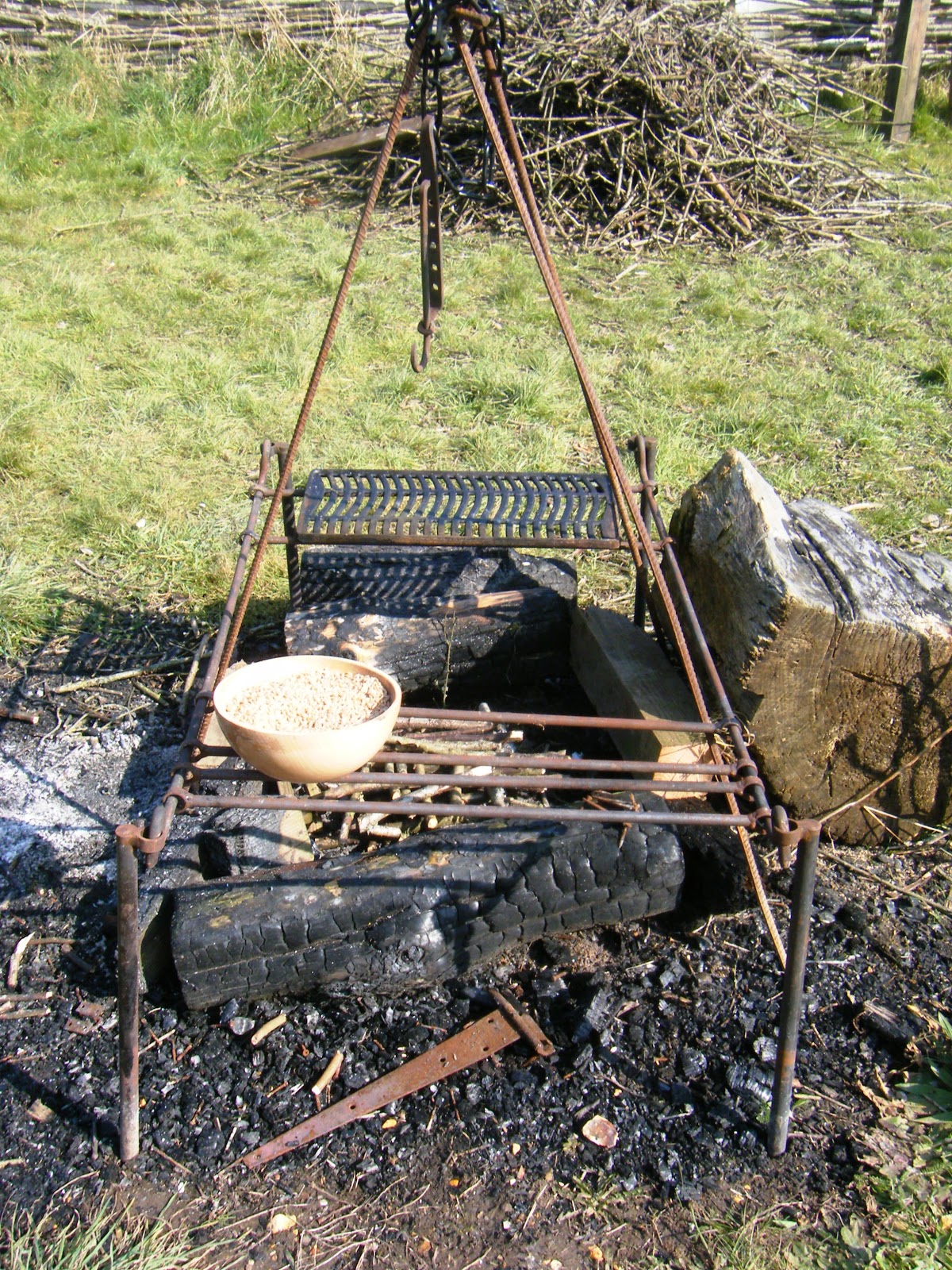

The present project is the construction of a 'henge' with central 'dolmen' (a stone room in which the dead were placed), which the kids are actively engaged in making themselves. This is a mix of the two monument types, but one has to make compromises. They even moved the large stone themselves using wooden rollers! They are digging the surrounding ditch and making the bank, then digging the central holes for the stones, which are being set one a year, the last to be set on top of the others in 2015:
 |
| The ditch and one central hole being dug. |
Thursday, 14 March 2013

Tuesday, 12 March 2013
Down Farm, Dorset
 |
| Martin Green & WDDAG |
 |
| Martin's museum |
 |
| A very small part of Martin's collection |


 |
| Reinstated posts and pond barrow in background |
This is a short film of the group visiting the bowl barrow reconstruction. It was real archaeology weather!
A truly remarkable man dedicated to the archaeology of his area.
Subscribe to:
Posts (Atom)