Friday, 22 June 2012


Wednesday, 20 June 2012
Sites for Sore Eyes course (Famous Sites)

I am starting another course in September and if anyone is interested and live in the Bridport and Lyme Regis area let me know.
We will be ranging across several periods and looking at some of the best excavations carried out in the last 30 years or so - including:
- the most famous hillfort
- a prince's tomb
- the largest prehistoric mound in Europe
- the search for the Sacred Ring
- the chariots of the ancestors.
I did this course in Bridport and Frampton at the end of last year, so some old students need not apply. But a brand new course will be starting in January, so keep looking in.
Tuesday, 12 June 2012
Wareham site visit video
This is a short film of our visit to Wareham. Although a dull and damp day all the students enjoyed the experience. Just goes to show what dedicated local groups can achieve. Thanks to Robert Lancaster, site director.
No.1 Poultry
For the last session of 'Digging the Dirt' I looked at the site of No.1 Poultry in the City of London. This site allowed archaeologists to examine the full breadth of London's past, from it's foundation around AD 52, decline and ruin in the early 5th century, revival under Alfred the Great with expansion during the medieval period, it's rebuilding after the Great Fire in 1666 and development as the richest metropolis into the 19th century.
The statistics underline the nature of the dig:
- c.50 diggers at any one time
- c.42,000 fragments of pottery
- c.54,000 animal bones
- c.800 coins
- c.20,000 archaeological layers
The London area, before the Roman invasion, shows no significant settlement, with the various streams and tributaries of the Thames making for a wet and marshy location. The long-gone Walbrook stream ran near the site on its the way to the Thames and environmental evidence shows a it as a clear and clean water source.
This plan shows the roads and buildings erected in the 1st century, with artificial terracing making flat ground for wooden structures, with sheds and outhouses behind and used as workshops for light industry and manufacturing, with some residential. As a result the Walbrook to the east had already become silt-laden and subject to flood.
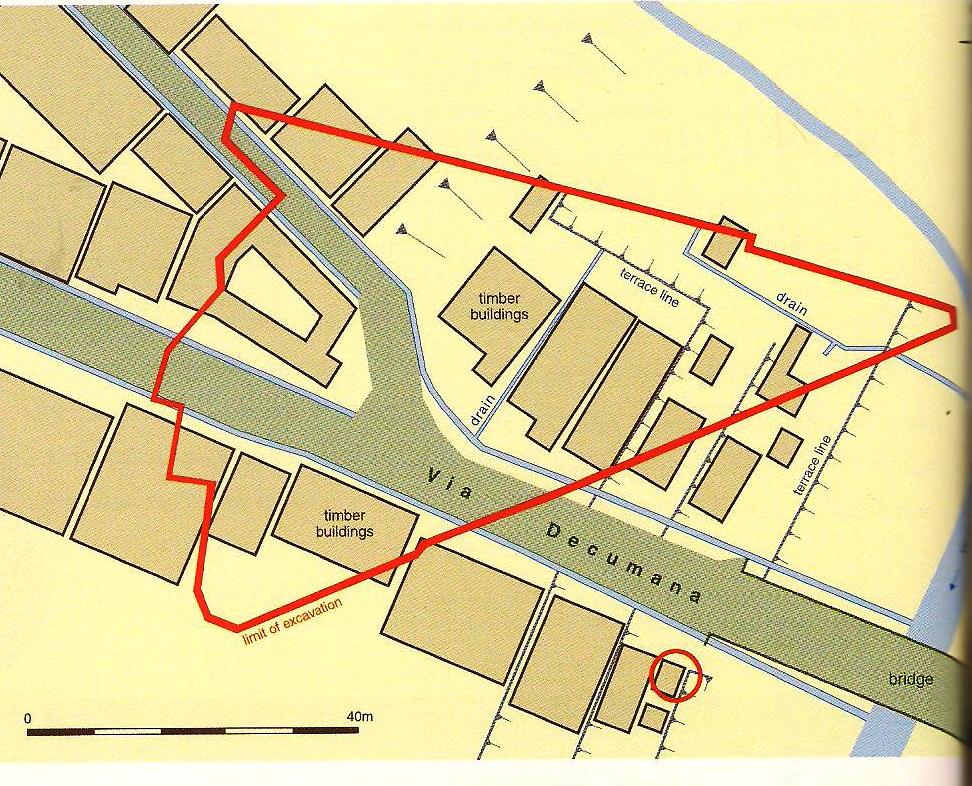
Some were shops and would have sold household goods, such as imported Gaulish wares and spices. Mixed in with the house keepers and shop owners would have been soldiers, as any new town was built and occupied by the army until citizen authorities took over. A large barracks stood in the north west area of the nascent city. It must have got lively at times.
After the Boudican revolt of AD 60 Londinium was built bigger and better. Some of the new buildings were constructed on large oak beams, with finds suggesting that this building was a bakery.

A remarkable find was a whole door, surviving due to the wet conditions mentioned above.

After the Hadrianic fire (London has burned down throughout its history) we see stone buildings replacing some of the wooden ones. We find the iconic symbols of wealth in Roman times, the mosaic, the hypocaust and tessellated floors.

London was abandoned after the collapse of the Roman Empire until Alfred the Great turned it into a fortified burgh in 886. By the 10th century London was once again the biggest settlement in England.

One of the main tasks for the archaeologists was to investigate the lost church of St Benet Sherehog (a shere hog is a ram castrated after its first shearing), seen here at the very edge of the site. Constructed in the 11th century it was destroyed in 1666. The Romans had a hand in its having to be rebuilt several times, because it kept sinking into a Roman drain!
 |
| St Benet Sherehog |
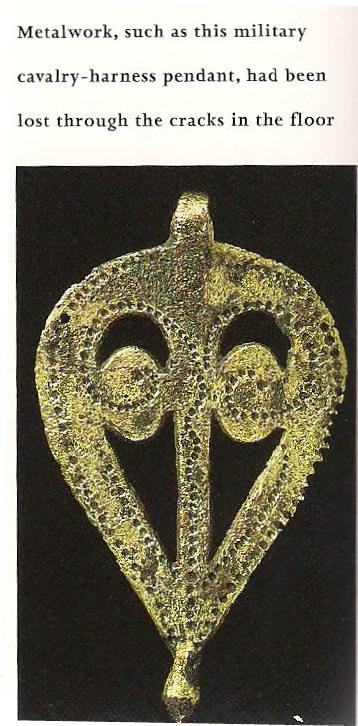
Metalworkers, smiths and ironmongers are well represented in the rows of shops and workshops. One road was called Ironmongers Row and the eastern end was 'La Lorimerie' after the Latin for strap 'lorum', where bridle pieces were made. The area was an international one, with one property owned by the Tolesan merchant family of Toulouse and the headquarters of the Society of the Riccardi of Lucca, who sold spices and textiles. They created the first money trading house and the Stocks Market also established itself here.
The striking survival of the Great Conduit, built between 1236 and 1245, is amazing. This brought in fresh water from the Tyburn and during coronations flowed with red and white wine!
 |
| The Great Conduit - the door led up to the street |
After 1666 the church of St Benet was no more, but the land continued to be used for burials. Some had distorted legs, tuberculosis and rickets due to malnutrition and some DISH (a spinal condition) which effects the obese. Rich and poor tended to live cheek-by-jowl until quite recently.
Even in London, where development continues apace, such a chance to excavate such a large area will not come again for some time and Poultry is one of the great digs since archaeology became part of the planning process in 1990.
Pictures: 'The Heart of the City' by Peter Rowsome
Friday, 8 June 2012
ARCHAEOTREKS-AUGUST BANK HOLIDAY

Come to Dorset for the August Bank Holiday. I will guide you through the unique Roman town of Durnovaria (Dorchester), the majestic Maiden Castle, to hear its 5,000 year old story and FIVE prehistoric sites that still dominate the heights above Abbotsbury and the Jurassic Coast. Plus two evening talks.
ITINERARY
Saturday evening: talk + drink & nibbles
Sunday: Maiden Castle & Dorchester; evening talk + drink & nibbles
Monday: five sites on the Dorset Ridgeway
£40 per person with children free (under 16).
I have several recommended B&Bs - with a 10% discount when you give them my name.
Please contact me to book (details above). I look forward to seeing you.
Wednesday, 6 June 2012
Shakespeare's Curtain theatre
 |
| The Curtain theatre is upper right |
Just in case anyone has not seen The Guardian today it reports that The Curtain theatre has been unearthed by MoLAS archaeologists. It has been discovered in a yard at Shoreditch. In the early 17th century the area was as rough as a badgers bottom, with slaughter houses and tanneries adding a particularly interesting odour. It is interesting to note that the site survived due to its being an open area and then mainly houses and back yards, with little deep excavations for cellars or foundations for large buildings.
This theatre preceded the more famous Globe, but was dismantled in the 17th century and its exact location subsequently lost, although the plaque marking the best guess was not that far away.
Built in 1577 it is one of the earliest theatres in London and was where the first showings of Henry V and Romeo & Juliet occurred. The MoLA team have uncovered areas of exterior wall, which is vital for calculating the dimensions of the building. They have also found fragments of money boxes, used to take the entrance fee and then smashed!
 |
| Tudor Money Box - MoLAS archive |
Finding such an important building is exciting enough, but this is in the middle of a Shakespearian summer-long international festival. It's almost as if MoLA had planned it...
Tuesday, 5 June 2012
Dorset Walks - July/August
I will be posting details of walks to Dorset sites during July and August soon, so keep looking in. They will also be in the Marshwood Vale Magazine.
Subscribe to:
Posts (Atom)