Tuesday, 21 August 2012

Ham Hill tour

Thanks to Hayley Roberts for showing us around the excavations at Ham Hill this past Sunday morning.

I had the wrong entrance, as the site is away from the main car park to the hillfort/country park area. I had to drive to where I had directed the students and herd them to the right place!

Once there Hayley gave an introduction to the work being carried out. The main focus is a large open area focused on trackways and enclosure ditches, some dating from the Bronze Age but mostly Iron Age. Some roundhouses and burials have also been found.


She then showed us some finds.


Which included:

A nice example of Glastonbury Ware
and:

A Roman ballista bolt
We then had a look at the smaller trenches being cut across the ramparts.


One of the trenches through the ramparts had unearthed some in situ pottery.


Most exciting for me was meeting Nail Sharples, who dug Maiden Castle in the '80s. This was a rare chance to see a hillfort under excavation and everyone was grateful to Hayley for taking us around.

Wednesday, 15 August 2012

Ham Hill Map


For all those that are coming to Ham Hill this Sunday here is a map. Yeovil is to the right and the blue P is where you are aiming for. There are signs from Yeovil. I'll be around wearing a hi-viz vest. See you there at 10.45am.  

Thursday, 9 August 2012

Archaeology Courses


I have two courses starting in September: one at Bridport on the 9th at the Quakers Meeting House, South Street and the other at Beaminster Museum on the 12th. Both are in the evening 7-9pm. £80 for ten sessions including two site tours and refreshments. The course is called Site Stories and will be about some of the best and most famous sites excavated in England.
Contact: 0776 869 51 62

Tuesday, 7 August 2012

Walks - 11th & 18th August

Durngate Forum
For Dorset locals I have a walk in Dorchester (meeting at the library) on Saturday 11th and one starting at Little Bredy church on Saturday 18th to see the Long Barrow. Both 10.30am and should last about 1.5 hours.  

Hope to see you there.

Ayia Triada

The royal villa of Ayia Triada was erected in the New Palace period c. 1600 BC and was destroyed at the end of the 15th c. BC. It was decorated in palatial luxury, with gypsum facing slabs, painted floors and wall paintings. It is in the shape of an irregular L.


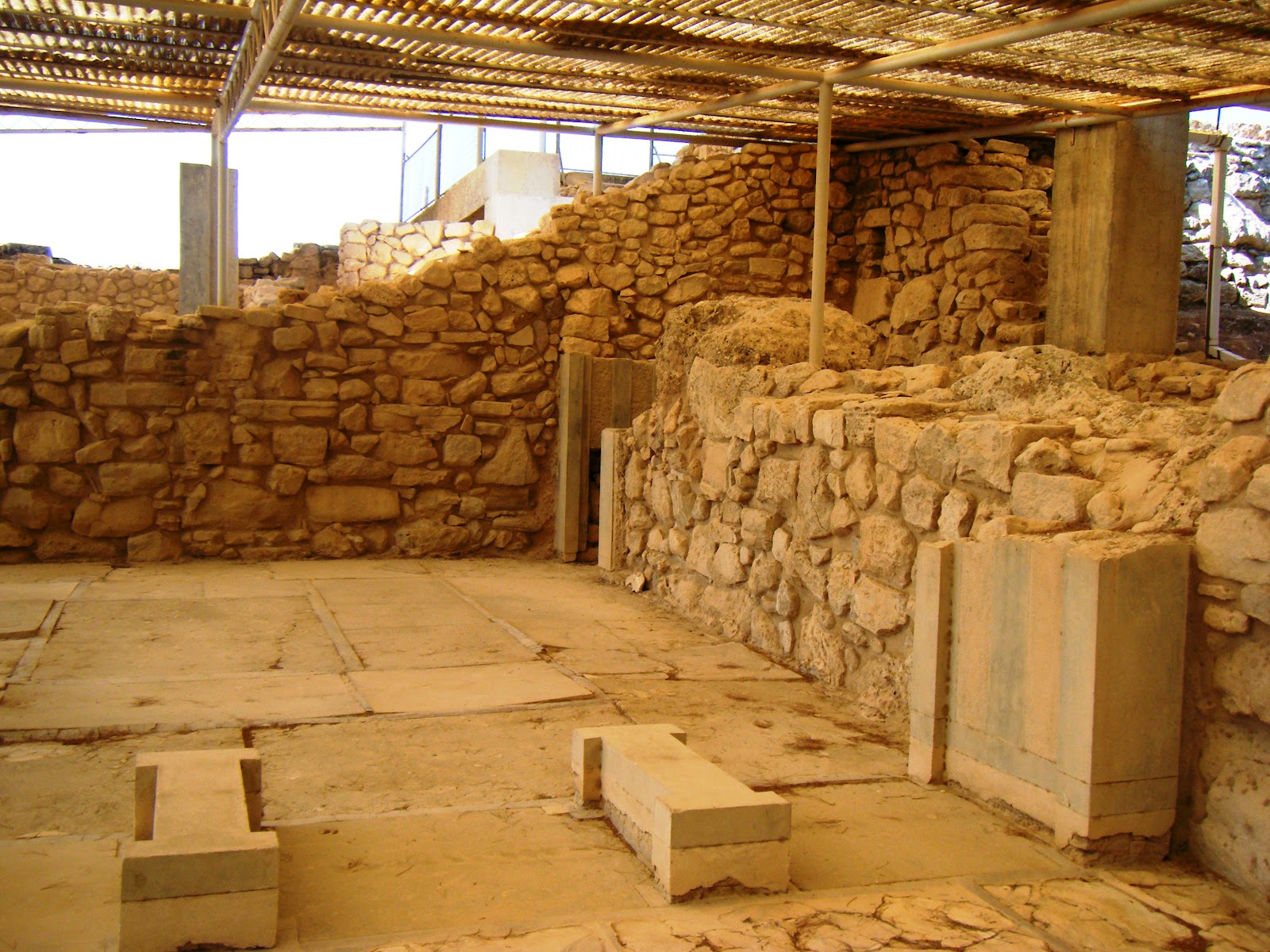
The ruler's quarters are in the north-west corner of the complex and comprise of the main hall, a portico and light-well, a room with a 'bench' and a revetment of gypsum slabs and a peristyle courtyard with fine views.


The Minoan settlement, the 'village' of the New Palace (17th-15th c. BC) and Post-Palace (14th-13th c. BC) periods lies to the north of the villa. The 'agora' was erected in the square on the east side of it and was a large complex of eight storerooms or shops, fronted by a long rectangular portico with columns and pilasters.


Later, sanctuaries were built in the Protogeometric and Geometric periods and the sanctuary of Zeus Velchanos functioned in the Hellenistic period. There are also sporadic finds from Roman and Venetian-Turkish times. 

Whilst there I chatted with the Italian director of the small dig taking place this year and he showed me around the site and some of the finds.

Tools of the trade

Artefacts

Some fine stonework
Special mention should be made of the unique stone sarcophagus, painted with composite scenes showing the cult of the dead.


Tuesday, 31 July 2012

Phaistos

I revisited the Minoan site of Phaistos, as I was last here in 2001, and came away with a better understanding of the site. The old palace complex is established and this is the flight of steps ending at a later wall ('we're on the [stairs] to nowhere' - Talking Heads) with a raised walkway leading to it.


Just to the south are large circular structures that were possibly silos for the storage of grain.


The later west 'propylaea' is very impressive and consists of a landing, a porch with a central column, a portico and a light well. 


The north wing includes the complex of the 'royal apartments'. 


The official character of these rooms is emphasised by the monumental facade of the wing facing the main gate and with painted niches to either side for the guards posted at the gate, which is flanked by half columns.

  
The main court preserves its paving, dating from the Protopalatial period (1900-1700 BC).


Two rooms are off especially luxurious construction, with walls revetted with alabaster, paving slabs, wall-paintings and flanked by light-wells, balconies and a large peristyle courtyard. 


Next blog post is on Ayia Triada, where I bump into some fellow archaeologists.

Tuesday, 3 July 2012

Crete Archaeology


I'm off to Crete next week, so look out for some reports and pictures of the archaeology of this beautiful island.