Monday, 30 April 2012

Beware of Greeks Bearing Gifts - away

It has been reported that thieves have dug a 6ft hole into an area of Olympia, where there is a known Mycenaen cemetery, in search of artefacts. This is because of the economic crisis affecting that country. The illegal digging has increased as people become desperate plus professional gangs know that there are cuts in guards at Greek heritage sites. 

But, local people are mounting volunteer guards to try to see off the robbers. Local people care about their heritage and also know that tourists come to see Greek sites. If sites are trashed they won't come. The culture ministry even reburied an early Christian basilica, found during work on a new underground railway, so that it may avoid looting. They knew that if a site became public knowledge the vulture will circle. At Pella, the ancient capital of Macedonia at the time of Alexander the Great, digging was abandoned after ten holes appeared over night.
The incredible Pella helmet

The artefacts are smuggled out by the gangs to unscrupulous dealers, auction houses (naming no names, but some well known) and collectors. Some of the artefacts can be worth millions of Euros. 

Greece has lost some 10% of its archaeologists and has just 2,000 security personnel. Museum staff have been laid off and are hit by robbers, smashing cabinets and taking metal and pottery artefacts worth millions. In one museum dead batteries had been placed in the security system! 

The Association of Greek Archaeologists, Ms Koutsoumba, stated that "we want the people of Europe to understand that when you see reports of cuts in the public sector, it's not just abstract. They are schools, nurses, monuments and museums". 

Each theft is like a surgeon taking a scalpel and cutting away bits of the brain bearing memories of the human race.  

Friday, 27 April 2012

Digging a Feature II


A Context Register
The context register has the Site Code in the top left corner. There might be several or even dozens of these sheets in a site folder and you just take the next numbers. Remember to put the fill numbers first and the cut number last. The other columns will be explained later. 

A Context Sheet
These context sheets are the only record of all features dug on the site and are thus of paramount importance. The numbers you take out are written in the top right corner box and the site code in the box next to it. The next box to the left is the site name, which could be the two or three letters representing village or road on which the site is situated. We will come to the Grid Square box later. 

DtD into June

The Digging the Dirt course is open until the 6th and 17th June for those who wish to come along on Wednesday (Dorchester) and Sunday (Bridport) evenings. Also for the site visits to two excavations! Contact me a.s.a.p.  

Thursday, 26 April 2012

Spitalfields

As part of my 'Digging the Dirt' course I am looking at some of the great sites I have worked on in London. One of the most remarkable is the site at Spitalfields in east London. 

Spitalfields & site
The main focus was on the medieval priory and hospital of St Mary Spital and its thousands of burials. But below that level was a Roman cemetery, where one of the most important finds was made. This was a rare 4th century limestone sarcophagus in which was contained a lead coffin.

Lead coffin in sarcophagus

The scallop shells are an indication of the pagan belief of the journey to the Underworld. A layer of silt in the bottom of the coffin preserved organic materials, such as bay leaves, used to form a pillow and textile fragments of wool and silk with gold threads. 

The person interred within was a woman in her early twenties and isotope analysis on her teeth showed that she came from northern Spain. 

The skeleton in situ

She obviously came from a wealthy family, perhaps the wife or daughter of a London governor. Her face was reconstructed by the Meet the Ancestors team.

Reconstruction of the Roman 'Princess'

The artefacts from the burial were also very special. One was a unique glass phial with a zigzag pattern and of the highest quality.

 
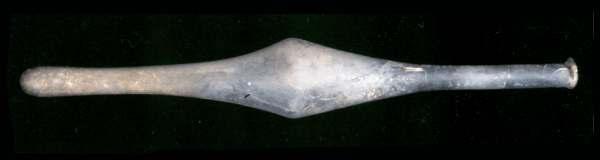
Associated with this phial was a Whitby jet rod for extracting the contents. A second glass phial had a bulbous centre.

  
The Spitalfields woman is the most startling find from this grand cemetery just outside the old Roman Bishopsgate. John Stow, in the 16th century, reported in his 'A Survey of London', of many Roman finds unearthed during quarrying in the area. One shudders to think of how much has been lost over the years and centuries. 

Thursday, 19 April 2012

Archaeotreks Weekend


The 5th & 6th of May will be a weekend to visit Dorset for walks to archaeological sites. Book with me for 4 walks this bank holiday. Stay in recommended B&Bs and save 10%!

Contact: tripp.chris60@gmail.com or 0776 869 51 62


Tuesday, 17 April 2012

Divine Women BBC2

Here is a rare chance to see a programme about women in prehistory and their place in religious development, fronted by Betany Hughes (again). Hold on tight, because it really rattles along, having been given the task of condensing a huge subject into only a few hours TV. So, lets not knock it too much. I will have a look at the rest of the series and hope that all the gaps are filled, to a greater or lesser degree. Also, it is becoming easier to ignore the usual 'filler' shots of Hughes against a setting sun, or walking across a landscape, or.... etc etc. 
Golbekli Tepe carving
The first programme starts at around 12,000 BCE at the Gobekli Tepe, Turkish 'temple', site. Hughes points out a carving of a squatting female figure (which I have had to draw - I could find no images on the web, strangely), which she states is 'sexual' and perhaps the woman is being penetrated or giving birth. If it had been a man saying that one may possibly say it was a typical male interpretation. If one looks at various literature it is more likely that she is the 'fountain' of life giving waters (see other posts too). She had introduced the site as being the first evidence of 'organised religion as we know it' and that, because this was a pre-farming society, 'religion was forming human society' not the other way around. So, if you find a temple it must be organised.

So here we have a very early site (Mesolithic), possibly a temple, with a female carving, which is possibly the first evidence of 'organised' religion. Hughes had mentioned in passing that female figures have been carved from the Palaeolithic, then passed on immediately to the Mesolithic without any more reference to it.

Venus of Willendorf 24k-22k BCE

That may be in the next programmes. But that did not put the following information into context. That context is one of many thousands of years of female carvings created during the Palaeolithic and as such leaves the rest of the information in the programme 'hanging'. Also, just because the people of the Palaeolithic did not possibly leave structures (temples?) does not mean that they did not have an 'organised' religion. That would mean that Druids did not have an organised religion. 

At Catal Hoyuk, again in Turkey (directed in the field by my old colleague from Passmore Edwards Museum days, Shahina Farid), this early Neolithic site had many female figures and bulls carved and painted in the dwellings. No other mention was made of the bull connection to the female figures (important for this site and its interpretation). Shahina makes a very interesting statement about how the female burials show that they were 'skinny', whereas the female figurines are, what would now be termed, clinically obese. Shahina is, as usual in the profession, loathe to mention the G word in relation to the figurines, but the fact that they are fat and the real women thin may indicate that they are representations, not of 'ideal' real fertile women, but the goddess of all life, as at Gobekli Tepe and the figurines from the Palaeolithic. I cannot believe that Shahina has not heard of the earlier figurines, so can only surmise that she has dismissed any connection to them and her site, which she states is the 'beginning of the goddess form'. I would disagree (by a few thousand years!). 

One figure that I had never seen before, from this site, was this one: 


It shows a woman plump in front and as a skeleton behind. Striking and a bit unsettling. I was immediately struck by the similarity of the figurine I have shown before -  this one, the so called 'birth goddess': 
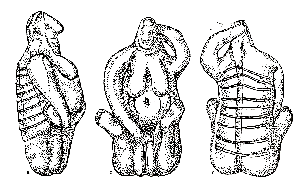
From Tarxian, Malta
Again, I believe that it shows the goddess as life giver and life taker, as in many cultures down the ages. She gives life and we return to her. 

I think that sometimes being a professional, with responsibilities and a fear of reputation being trashed, can suppress thinking and interpretation too much. One must always be looking over ones shoulder in case of ridicule and loss of face (and job). Luckily no one returns from the past to make fools of us all. But wouldn't it be wonderful?